
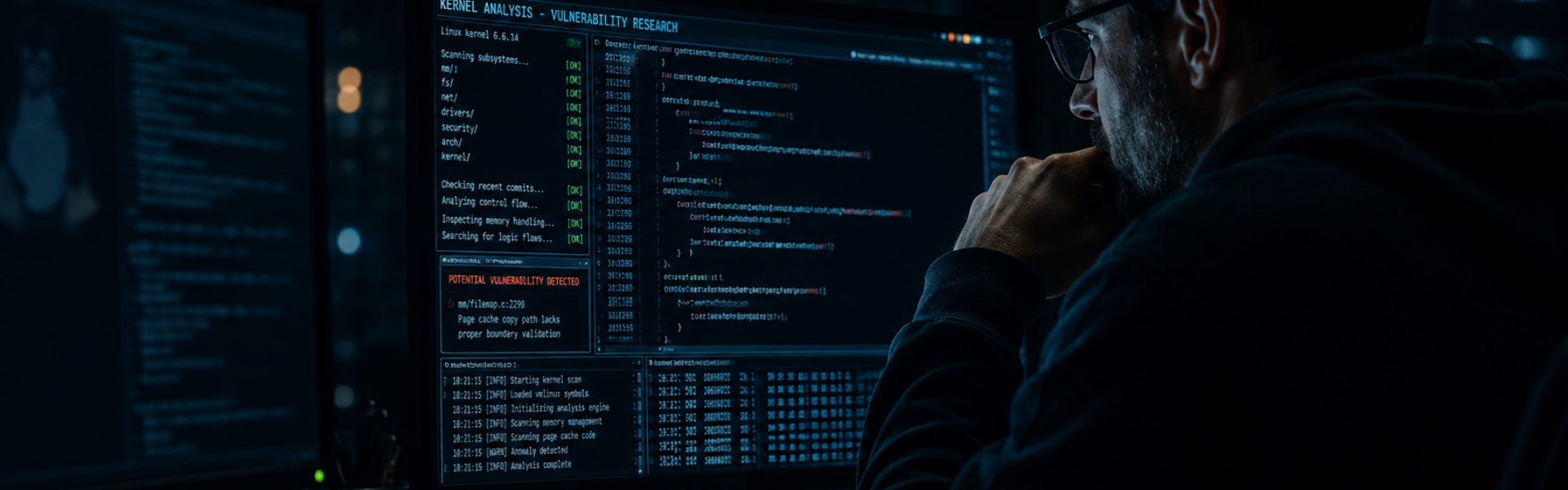
In recent weeks everyone in the Linux community has been talking about “Copy Fail”, a deterministic page-cache corruption flaw that works consistently across major distributions.
Obviously, here at Tiger Computing we’ve spent many hours assessing its potential impact (as well as a related vulnerablity Dirty Frag) on our clients’ environments, applying mitigations as we awaited patches to become available, and then managing their deployment. But now that the dust has settled somewhat, I’ve found myself thinking less about the patching process and more about how the flaw was discovered in the first place.
A logic flaw that sat quietly inside the Linux kernel for roughly nine years – surviving manual review, production usage, static analysis, and countless fuzzing runs – was reportedly identified by an AI-assisted research platform in around an hour.
That is a significant moment for the Linux community. Not because AI has suddenly become magical, but because it changes the economics of discovery.
The End of “Trusted” Code?
I’ve spent most of my career believing, broadly speaking, in the “many eyes” theory of Open Source: that given enough users, enough scrutiny, and enough time, the important bugs eventually become visible.
Copy Fail challenges that assumption.
This wasn’t some obscure abandoned utility buried in a forgotten GitHub repository. The flaw existed inside one of the most heavily deployed and professionally scrutinised software ecosystems on earth.
And yet it appears to have been identified not through traditional review, but through what I’d describe as agentic discovery: AI-assisted systems systematically exploring relationships between subsystems and identifying unusual logic paths at a scale humans simply cannot sustain manually.
Finding a deep kernel flaw used to require months of human labour; now it requires an hour of compute time. When the cost of finding a vulnerability drops to near zero, the way we defend must change fundamentally.
And the speed of weaponisation only reinforces the point. When 100% reliable exploits can appear in days, we need to move past manual discovery.
AI Doesn’t Get Bored of Infrastructure
Human engineers are excellent at contextual reasoning. We understand architecture, operational trade-offs, and intent. We’re very good at deciding why systems behave the way they do. What humans are much less good at is maintaining identical levels of concentration while reviewing vast quantities of old, uneventful code.
AI systems don’t really have that limitation. They can inspect legacy memory-management routines at 4:00 AM with exactly the same persistence they had at 9:00 AM. They don’t mentally downgrade a subsystem because “that part has probably been fine for years.”
And this is where the implications become much broader than Linux. Because the modern world runs on enormous quantities of “boring” infrastructure:
- Banking systems
- Industrial control platforms
- Healthcare environments
- Power infrastructure
- Legacy enterprise middleware
Code that is mature, stable, rarely touched, and generally trusted.
Historically, the obscurity and age of these systems acted as a kind of accidental defence layer. Not intentionally, but operationally. That era may now be ending.
The Defensive Opportunity Is More Interesting Than the Threat
For years, infrastructure security has largely been reactive:
- Wait for CVEs
- Apply patches
- Assess exposure
- Repeat
But if AI-assisted systems can identify deterministic logic flaws inside the Linux kernel, then logically those same techniques can also be applied defensively. And they are.
The Rise of the AI-First Defender
The defensive side of the industry is already responding. The same agentic discovery that unearthed Copy Fail is being folded directly into the defensive line.
One of the most promising examples is the Alpha-Omega Project, a joint venture between the Open Source Security Foundation (OpenSSF) and the Linux Foundation. In early 2026, they announced a landmark $12.5 million investment to equip maintainers with advanced AI-driven security tools (source:Alpha-Omega Project). The goal is to move beyond discovery and toward automated remediation.
Similarly, Google’s OSS-Fuzz has transitioned into a fully AI-augmented platform. By integrating Large Language Models (LLMs) to generate “fuzz harnesses” (the test code used to find bugs), the system successfully identified over 60 real-world high-risk vulnerabilities in 2025 alone, including a 20-year-old bug in OpenSSL (source:Google Security Blog).
Even DARPA has entered the fray with its AI Cyber Challenge (AIxCC). At the 2025 finals, autonomous “Cyber Reasoning Systems” were able to identify and patch 86% of synthetic vulnerabilities and even discovered 18 previously unknown real-world bugs in critical C and Java codebases (source:DARPA AIxCC).
For the first time, we are entering a world where infrastructure can be examined continuously rather than periodically. AI systems can already scan custom infrastructure stacks every time a line of code changes, identify where a seemingly minor logic flaw in one subsystem could lead to a host-level escape, and monitor kernel behaviour for unusual execution paths that would never normally attract human attention. Instead of waiting for a crash, a ticket, or a published CVE, we are moving towards continuous introspection at machine scale.
The Challenges: Noise, Hallucinations, and the Human Limit
However, it would be naive to suggest that AI is a silver bullet. As we integrate these tools, we are running into three significant challenges:
1. The Signal-to-Noise Ratio
While AI is great at finding potential bugs, it is also prolific at generating “false positives.” In fact many organisations use secondary AI layers just to filter out the “noise” created by their primary scanners.
2. The Hallucination Gap
In the world of the Linux kernel, a patch that is 99% correct is 100% broken. AI models can occasionally “hallucinate” logic, suggesting patches that appear sound but introduce subtle, secondary vulnerabilities. Research into tools like GitHub Copilot has repeatedly shown that while they significantly increase developer speed, AI-generated code still requires careful human review, particularly in security-sensitive environments.
3. The Human Bottleneck
AI can find a thousand bugs in an hour, but there aren’t enough kernel maintainers in the world to review a thousand patches in a week. The bottleneck has shifted from finding the problem to validating the solution.
The Linux Professional’s Role Is Changing
If Copy Fail has taught us anything, it is that the “Many Eyes” of the community now have a powerful set of digital lenses to assist them. We are moving away from an era of manual, reactive patching and into a period of continuous, intelligent introspection.
I don’t believe these AI systems will replace the experienced Linux engineer. If anything, they make the human element more critical than ever. We still need the architectural judgement, the contextual understanding, and the creative reasoning that only a seasoned professional can provide. What is changing is our toolkit. We are moving from being “firefighters” who react to the latest CVE, to becoming “systems strategists” who use machine-scale insights to build more resilient environments from the ground up.
As we look toward the future of our infrastructure, the goal isn’t just to find bugs faster. It’s to understand our systems so deeply that we can anticipate where the next logic flaw might hide. At Tiger Computing, we’ve always believed that specialist knowledge is the best defence.
In this new era, that knowledge is simply amplified with AI.